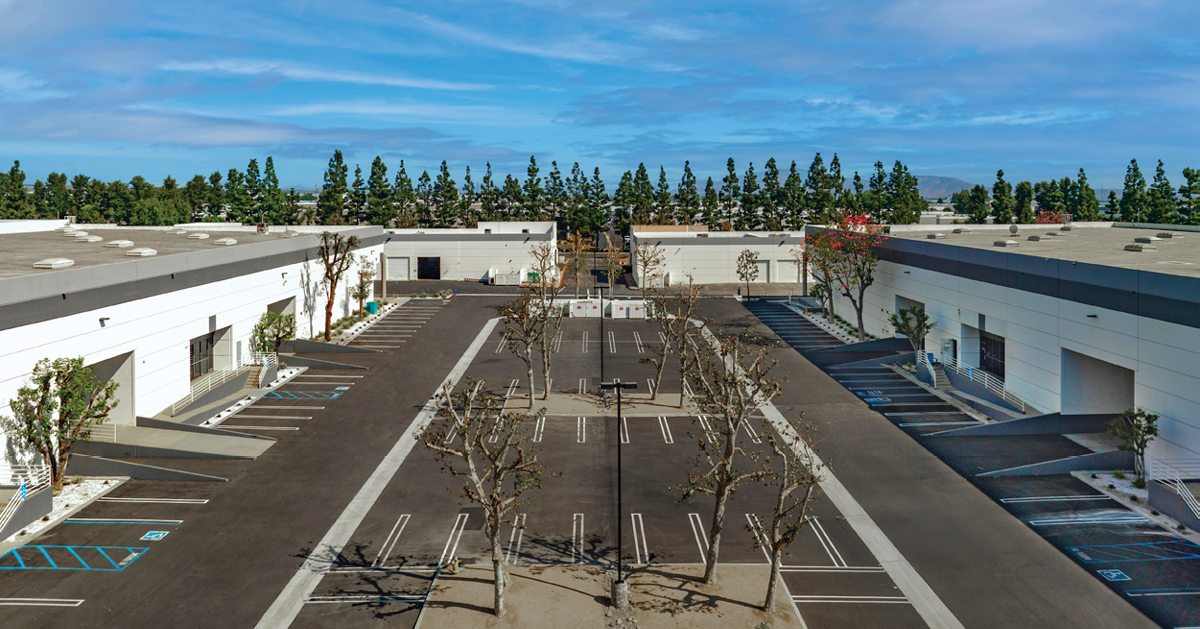
As economic uncertainty, driven by escalating oil prices, tariffs, and a weakening labor market, continues to plague the industrial market, private investors seeking durable cash flow are turning to flexible small-bay properties.
“For private local investors who don’t have the ability to weather the storm of vacancy on a larger building, small-bay industrial assets can be an attractive investment,” says Tom Terry, vice president and industrial specialist in Voit’s Anaheim office. “If you have a 32,000-square-foot building with a single tenant, you’ve got nothing. But in a multi-tenant shallow-bay building, if you lose one or two tenants, you can still have cash flow.”
 Small-bay industrial is emerging as one of the strongest segments of the U.S. warehouse market, with good reason. While the national industrial vacancy rate was around 8% in the first quarter of 2026, a report by Newport Beach-based BKM Capital Partners, a real estate investment firm focused exclusively on small- and mid-bay light industrial properties, stated that buildings under 50,000 square feet averaged 4% vacancy. Properties in the 5,000- to 10,000- square-foot range had an even lower vacancy rate of 3.2%.
In Orange County, buildings in the 100,000- to 250,000-square-foot and 250,000- to 500,000-square-foot categories exceed 13% vacancy. “The rate for that last category has more than doubled since the start of 2024 as speculative big-box deliveries collided with softening demand in third-party logistics,” according to a recent CoStar report. Vacancy for buildings in the 50,000- to 100,000-square-foot range is 6%, while vacancy for buildings under 50,000 square feet registers under 4%.
Defining Small-Bay Industrial
Many CRE organizations define small-bay industrial properties as those under 200,000 square feet, with individual tenant suites ranging from 1,000 to 10,000 square feet. In its white paper, Go Big in Small Bays: The Definitive Case for Small-Bay Industrial Real Estate, Basis Industrial, another real estate investment firm focused on small-bay and multi-tenant industrial, further narrows that definition to “properties or portfolios with Multiple Tenancy, where no one tenant makes up more than 10% of the rent roll, and the average size tenant is under 10,000 [square feet].”
 Basis Industrial listed the characteristics of small-bay properties that make them irreplaceable assets that allow small business owners to house all operations under one roof:
- Typical ceiling clear heights of 12–24 feet. Modern large distribution facilities typically have clear heights over 30 feet.
- Higher office-to-warehouse ratios (often 25–50% office buildout).
- Flexible layouts adaptable to various uses, including light manufacturing, assembly, distribution, showroom, destination retail, and service operations.
- Locations in established markets often referred to as “urban-infill” or “last-mile” near population centers, labor pools, and end consumers.
Small-bay spaces are home to a wide spectrum of business types, from HVAC contractors and plumbing companies to light manufacturing and e-commerce fulfillment operators. The tenant base includes “countless other essential service providers that form the backbone of local economies.”
In April, the Small Business and Entrepreneurship Council estimated that, of the just over 6.4 million employer firms in the U.S., 98.2% had fewer than 100 employees, 89.4% had fewer than 20, and 79.2% had fewer than 10. Of the 239,265 U.S. manufacturing firms in 2022, approximately 75% had fewer than 20 employees and 93.1% had fewer than 100 employees, according to a report by the National Association of Manufacturers (NAM).
Demand Exceeds Constrained Supply
According to the BKM report, “Demand for multi-tenant light industrial assets consistently outperformed that of larger-format properties. On average, 70–80% of all leases transacted are under 50,000 square feet, despite the size segment comprising only 31% of all industrial inventory.” New supply is scarce, and the construction pipeline is highly constrained.
Build-to-suit projects accounted for almost 27% of all new industrial projects under construction in Q1 2026, a 42% increase over the 2024 figure. Only 7% of the under-construction inventory is for buildings under 50,000 square feet. The report also noted that “just 36 million square feet of small-bay assets are currently under construction nationwide, representing less than 0.3% of total industrial inventory.” The CoStar report stated that “construction of industrial buildings under 100,000 square feet in Southern California has dropped nearly 80% from its high point to a decade-plus low of 1.6 million square feet.”
Terry says that is especially true in Orange County. “They’re irreplaceable assets. The land basis is too expensive for those to make any sense. You’ve got to build 24 loading doors, 24 bathrooms if you’re talking about individual units, and 24 front doors. The cost is way higher than it would be to just build one box.”
Further complicating the supply picture is the age of many of the properties. Of the existing small-bay inventory, 83% was built prior to 2000 and only 5% since 2010. This lack of new small-bay construction is creating significant repositioning potential for value-add operators.
Lack of Supply Creates Opportunities for Investors
A report by CREDA (formerly NAIOP) noted that, in Q3 2025, approximately 70% of industrial property trades were under $100M (the highest share in over a decade) and almost 50% of the acquisition volume was by private buyers. This shift toward smaller transactions suggests the market sees the value of properties that offer near-term rent growth and manageable capital requirements.
Many investors are acquiring older shallow-bay space, renovating the properties, and achieving higher rents. “Nothing is being built. It’s too expensive, it doesn’t pencil,” Mason Waite, senior managing director of asset and portfolio management at BKM Capital Partners, told CoStar. “There’s always a lower-cost alternative, so our thesis is to provide a nice product and invest heavily in it: paint, signage, roofs, and more efficient layouts. A lot of these buildings haven’t been invested in on the interiors; the floor plans are funky. It’s a hands-on, efficiency-build approach.”
The lure of small-bay assets is also driven by rent premiums. In its white paper, Basis Industrial reported that “small-bay commands 20–22% higher rents per square foot than bulk industrial.” According to CoStar, $1.61 PSF was the average asking rent for buildings under 50,000 square feet listed on its website at the end of Q2 2026. Market rents are stabilizing at record levels, up 20% from five years ago.
Potential Pitfalls for Small-Bay Investors
In addition to outlining the benefits of small-bay asset ownership, Basis Industrial notes potential downsides, which it describes as manageable: more intensive property management and greater credit risk from smaller tenants.
“The credit for some of these users is not great. They’re usually startups or someone coming out of their garage, with little to no operating history or working capital,” says Terry. “So, we’re seeing investors requiring larger security deposits.”
An In-Depth Overview
CREDA recently published a white paper, Developing, Owning and Operating Shallow Bay Industrial Buildings, which provides an in-depth overview for investors. The report concludes with this statement: “…renewed interest in shallow bay industrial buildings reflects a broader recognition that smaller, locally oriented industrial assets can offer compelling risk-adjusted returns when they are acquired, financed, designed, leased and managed with discipline…Moving forward, they are likely to reward sophisticated operators with patient capital who are willing to devote both time and resources to careful deal selection and thoughtful deal execution.”
To learn more about investing in Southern California small-bay assets, contact one of Voit Real Estate Services’ trusted commercial real estate advisors.