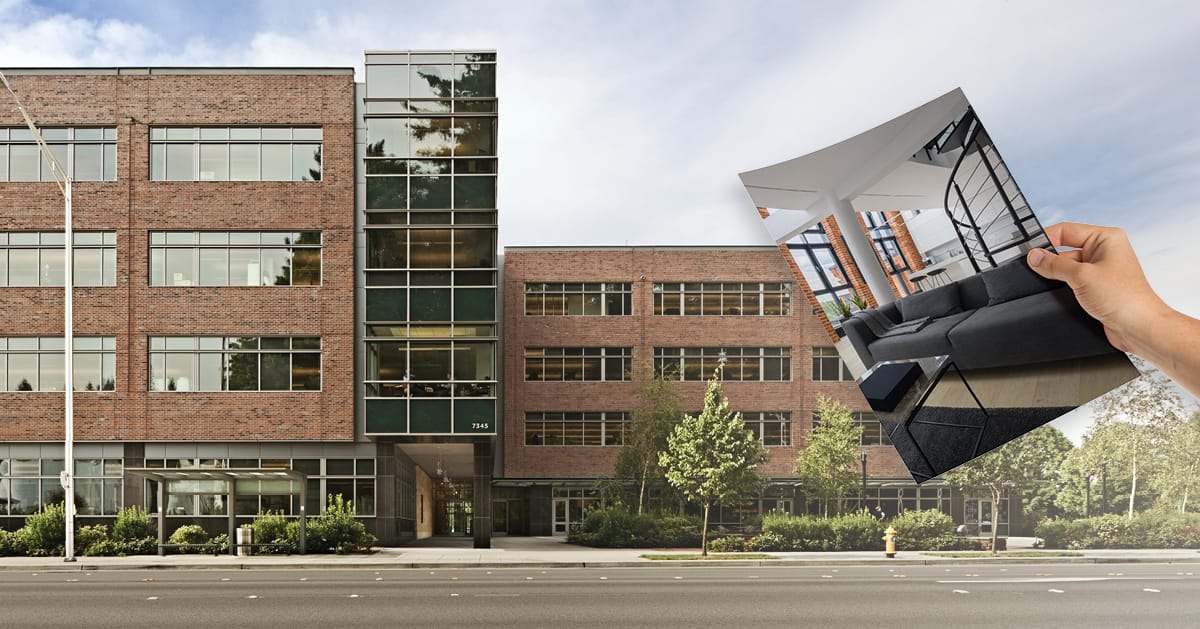
It’s time for our annual(ish) examination of the trend of converting underperforming office buildings into multifamily buildings. It’s clearly accelerating, as the lender practice of “extend and pretend” (where lenders extend the maturity of a loan to avoid recognizing a loss) appears to be running out of steam, especially since interest rates held steady at the last Federal Reserve meeting and many analysts predict they will rise by year-end.
 As a recent Yardi Matrix report notes, office-to-multifamily projects reached the highest level recorded for any year in 2025, with a total of 11.8 million square feet completed or under construction. Rent Café, Yardi’s multifamily data arm, reported in March that “at the start of 2026, 90,300 apartments were in the process of conversion nationwide — up 28% from 70,600 a year earlier — marking another record year for office-to-apartment projects.” The number of office properties being converted is nearly four times larger than in 2022 and now accounts for almost half (47%) of all future adaptive reuse projects nationwide.
What’s Driving the Trend?
The basic reasoning behind office conversions remains the same: hybrid work models drove down office space requirements, prompting many firms to trim their footprints and relocate into higher-quality buildings with more appealing amenity packages to attract and retain employees. This left many Class B & C buildings with unsustainable vacancy rates and insufficient cash flow to service their debt. Simultaneously, there was and continues to be a severe shortage of housing in major metros throughout the U.S., including Southern California. While the impact that office conversions have on the housing market is not considered significant, they provide property owners (or investors) with a viable avenue to reposition functionally obsolete office space.
When we first began reporting on the office-to-residential trend in 2023, the focus was on the feasibility (or lack thereof) of conversions. A report by Gensler stated that while only 25% of the office buildings they analyzed in North America were suitable for conversion, a large percentage of those buildings would not pencil due to structural issues and acquisition and redevelopment costs. As the years have passed, conversions have become more of a necessity due to elevated interest rates and a steady decrease in office valuations for B & C assets.
After three consecutive 25-basis-point rate cuts in 2025 and the promise of more in 2026, additional cuts have failed to materialize. Interest rates are expected to rise by as much as 75 basis points before year-end. Office valuations have also decreased dramatically since 2022. Although prices rose 4% over the past 12 months ending in May, they were 35% below their 2022 peak, according to Green Street.
“A massive amount of office building loans — over $213 billion — are coming due by the end of 2026,” Doug Ressler, senior analyst and manager of business intelligence for Yardi Matrix, told the Boston Business Journal’s Andy Medici. “When loans mature, borrowers need to either pay them off or refinance them. The problem is that many of these office buildings have lost significant value largely due to remote-work trends reducing demand.”
Unable to meet their loan obligations, property owners are selling office buildings — even former trophy assets — for pennies on the dollar. Lowering the acquisition basis to that degree helps make office-to-apartment conversions pencil out. Another factor contributing to feasibility is the proliferation of inventive programs by municipalities, which rely heavily on tax revenue from office buildings.
Incentives Drive Conversions
Interestingly, our December 2023 blog post, “Converting Office to Residential: Is It Possible?” cited an article by Deloitte that envisioned such a scenario: “A combination of some of the benefits provided by local governments can make the math work for conversions at scale. In particular, government incentive programs can help make conversions more feasible by easing restrictions around zoning and density, providing direct financial subsidies and tax abatements, and waiving or redistributing infrastructure upgrade costs to a longer time horizon.”
The federal government gave conversions a boost in late 2023, when it published a guidebook which provided an overview of below-market lending, grants, and technical assistance available across multiple agencies (including HUD, DOT, DOE, and the GSA) to help local developers convert vacant downtown commercial buildings into affordable and mixed-income housing.
State and local programs have further bolstered those federal incentives. In California, AB 1490, passed in 2023, created a fast-track, streamlined approval process for 100% affordable housing adaptive reuse projects. The legislation allows developers to convert existing commercial, office, and industrial buildings into residential or mixed-use housing without facing traditional local zoning hurdles, provided the projects meet strict affordability and labor standards.
Los Angeles
With a downtown office vacancy rate hovering around 35%, the City of Los Angeles has been especially active in offering incentives for office conversions. LA has been at the forefront of incentivizing adaptive reuse for decades. In 1999, the city enacted its initial Adaptive Reuse Ordinance, focused on the downtown. With zoning incentives and a more streamlined approval process, the ordinance allowed more than 12,000 units to be constructed. The city has continued to promote conversions through various programs over the years. In February, the Los Angeles City Council adopted the Citywide Adaptive Reuse Ordinance (No. 188793) that established zoning incentives and streamlined procedures to convert existing commercial buildings and structures into five or more residential units. The expanded scope of the ordinance allows buildings that are at least 15 years old to be converted “by right,” streamlining approvals and reducing bureaucratic delays that have historically slowed development. In April, the Los Angeles Sentinel reported, “City officials estimate the change could lead to the creation of more than 43,000 housing units.”
The new ordinance allowed Garrett Lee, president of Jamison Properties, to move forward with his plan to convert the World Trade Center building in downtown Los Angeles into 512 housing units. In a February interview with the Los Angeles Times, he said, “When you take that risk off the table, it materially improves the feasibility of conversions. It addresses both the housing shortage and the long-term office vacancy issue.”
Office Conversions “Not Temporary”
Franco Faraudo, editor of Propmodo (which dedicates significant space to office-to-residential conversions), recently penned an article, “Office Conversions Are Getting More Common. Here Is What the Developers Doing Them Best Have Figured Out.” He concludes the article with a concise, optimistic argument as to why conversions are here to stay:
“The conditions that have made office-to-residential conversions an increasingly attractive strategy are not temporary. As housing shortages deepen in major cities, as lower-tier office stock continues to struggle to attract tenants, and as more municipalities build the permitting frameworks that make conversion projects financially viable, the pipeline of viable candidates will keep growing. … The developers who have built the expertise, the relationships, and the operational discipline to execute these projects well have a meaningful advantage in a market that is only beginning to understand how large the opportunity actually is.”