It has been nearly six years since the pandemic radically altered the way we work. Work-from-home (WFH) strategies were already gaining traction before COVID-19, but the shutdown turned a growing trend into a survival necessity, allowing businesses to maintain operations. As the worst effects of the pandemic were brought under control and returning to the office became more viable, many office workers opted to remain in WFH mode.
However, employers began pushing back, citing a lack of spontaneous interaction among workers, an inability to create a company culture or onboard new employees, and a loss of productivity. “Fully remote work is associated with about 10% lower productivity than fully in-person work,” according to a Stanford University 2023 report. In recent years, most companies and their employees have come to a truce, settling on a hybrid workplace that appears to be a boon for both. A more recent StanfordReport concluded “that employees who work from home for two days a week are just as productive and as likely to be promoted as their fully office-based peers.” WFH also led to a drastic reduction in employee turnover, with resignations falling by 33% among workers who shifted from full-time office work to a hybrid schedule.
Evaluating Space Needs
While this is great news for employers and employees, it makes real estate decisions for companies increasingly complex. According to the human resources consulting firm Robert Half, 88% of employers offer hybrid work options, though this varies by individual circumstances and seniority level. Hybrid working arrangements for most companies are still evolving, with a trend toward more time in the office. Tuesday, Wednesday, and Thursday are the peak days for in-office work.
As the workplace evolves, so must the approach for companies leasing office space. In recent years, office users have shifted their focus from occupancy to utilization. The strategy for calculating office space has shifted from headcount-based (how many employees the company has) to behavior-based (how employees actually use the space). Keyless access control systems provider Kisi pegged average daily office occupancy at 52.1% in mid-February. While the figure has finally inched up over the 50% threshold, how that space is used is more critical to a business’s bottom line.
Utilization
Occuspace, a platform that measures space utilization in real time, recently published the Fall 2025 Space Utilization Index, which analyzed over 40 million square feet of space over 10,000 unique workspaces across multiple industries. The report concludes that, on average, corporate offices operated at a utilization rate of 40–50% for most of the year — meaning more than half of the space was unused. Further, utilization varied from day to day, with Tuesdays and Wednesdays at the high end and Friday (not surprisingly) at the low end. Financial Services lead all industries at 63%, followed closely by Legal and Professional Services at 59%.
The Evolution of Office Design
The Occuspace report indicates that companies are moving away from open-plan office designs and instead prioritizing designs that emphasize privacy and dedicated focus areas. “A typical hybrid office is now comprised of 40-50% focus spaces, 15-20% collaboration spaces and 17-25% amenity spaces,” which are an important component in attracting and retaining talent.
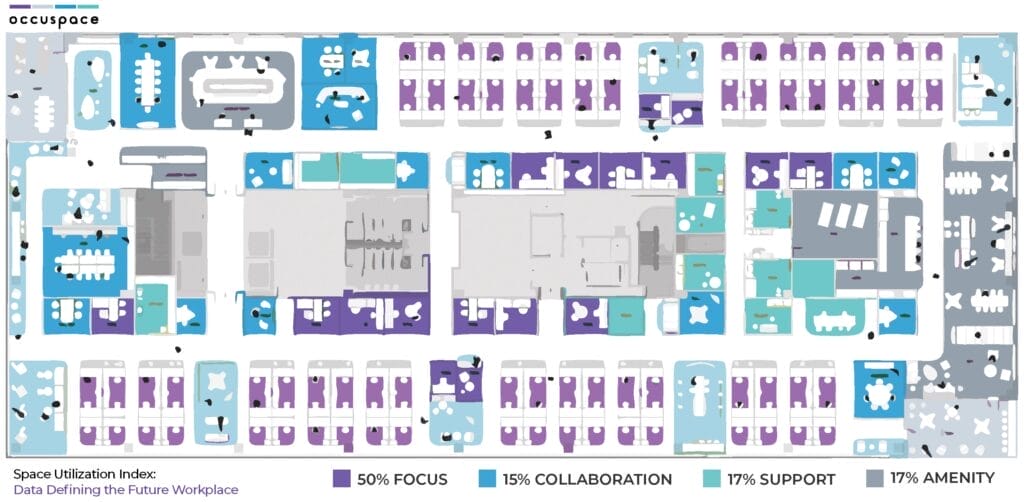
The report notes a significant gap between meeting room capacity and actual usage. While smaller rooms (designed for 1-4 people) are typically used efficiently, larger conference rooms are grossly underutilized. “The global average meeting room utilization is just 30%, with only one-third of the seats occupied when rooms are in use.” Occuspace also mentioned in a recent blog post that meeting spaces and conference rooms are “some of the most popular and yet some of the worst utilized spaces” in most offices. Since large conference rooms typically dominate an office floor plan and the average meeting size is well below capacity, there is a strong case for rightsizing.
Optimizing Space for Your Business
More and more companies are using office space utilization to plan more efficient hybrid work programs within their organizations. HubStar, a workplace management software provider specializing in hybrid work solutions, recently published the Essential Workplace Metrics toolkit, which provides a “how-to” on optimizing office space in a hybrid workplace. Below are a few key points pulled from the guide.
Occupancy & Vacancy: Track space availability and usage patterns to optimize workspace design.
Occupancy is the number of workspaces (desks, rooms, or zones) that are actively in use at a given time. Vacancy is the opposite of Occupancy, defined as the number (or rate) of an area without any occupancy. High vacancy may indicate wasted real estate costs, while high occupancy could indicate overcrowding and poor employee experience.
If occupancy is consistently low, consider downsizing or repurposing underused areas. If certain zones are consistently at capacity, consider expanding or reallocating space. It’s also important to monitor operational health, so track daily/weekly fluctuations to respond quickly to changes in demand, shifting team behaviors, or business needs.
Utilization Rate: Measure how efficiently your spaces are being used over time to assess underutilized or overcrowded areas.
Utilization shows how well your space is used, spotlighting underused or overcrowded areas. It’s essential for evaluating hybrid strategies and guiding space design decisions based on actual usage rather than planned usage, which is often quite different.
You can measure usage via sensors, booking systems, or Wi-Fi. You calculate utilization by dividing occupied space by total space for the length of time the space was available.
Average utilization provides a view of space usage, helping you identify areas for improvement. Peak utilization highlights the busiest moment in a given period, helping you understand when spaces or zones may be more crowded.
How to apply the data:
- Right-size and reallocate: Identify underused areas and rebalance team spaces based on real usage, not assumptions.
- Improve design and experience: Spot trends to adapt layouts that better support evolving ways of working and enhance employee experience.
- Avoid crowding and cut waste: Use peak data to forecast demand, prevent overcrowding, and reduce unnecessary spending.
- Justify changes with data: Use concrete utilization data to back up space allocation decisions and optimize based on results.
Attendance Patterns: Understand when employees are on-site to help with space planning and resource allocation.
Attendance data helps employers understand employee counts and hybrid working patterns, revealing whether people are following their planned schedules and how attendance varies across teams or days. Attendance patterns can be measured using access control systems, WiFi, sensor data, or booking system check-ins. For the most accurate picture, combine multiple sources. Actual attendance trends can be used to adjust anchor days or hybrid mandates.
Sharing Ratios: Monitor the number of people assigned to each workspace, to match office space to actual usage.
Sharing ratios measure how many people are assigned to a given number of desks or workspaces. Start by identifying the number of people using a space and dividing it by the number of seats available in that area. Benchmark by space type — focus zones, collaboration areas, meeting rooms — because not all areas should follow the same ratio. This can generate significant cost savings: higher ratios mean fewer desks, reducing real estate costs.
If your company is planning to expand, downsize, or relocate your office, contact one of Voit Real Estate Services’ trusted commercial real estate advisors.