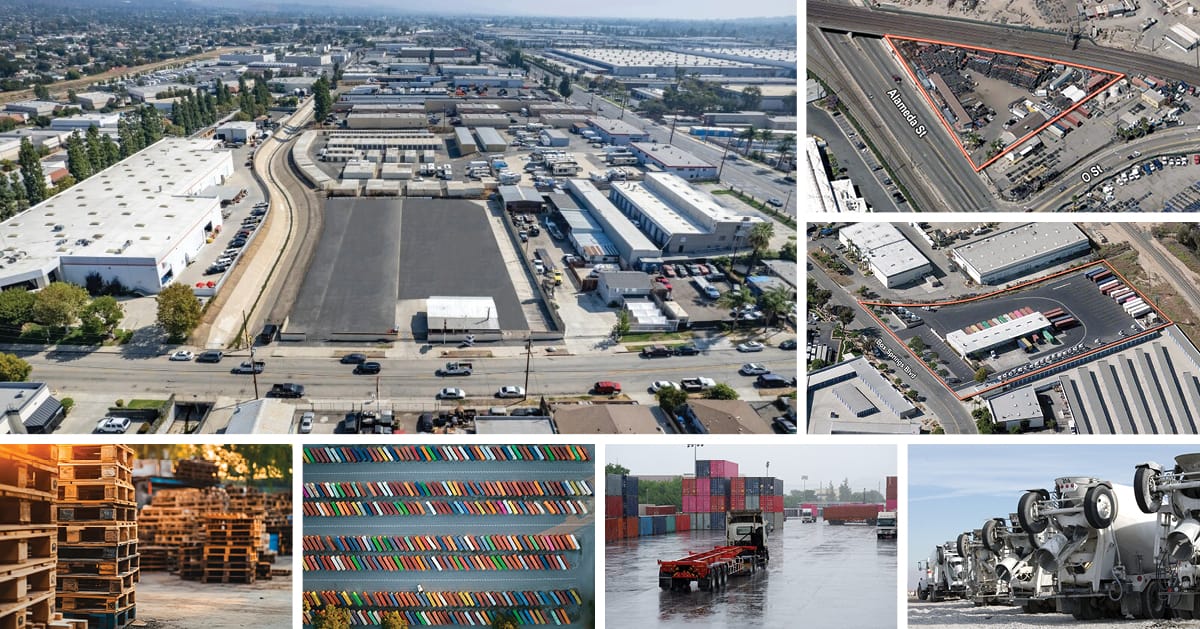
The Industrial Outdoor Storage (IOS) market appears to be rebounding from its post-pandemic slump. Institutional investors are taking notice. A Q4 2025 report by Partner Valuation Advisors states that IOS “has evolved from a niche asset class into a strategic investment target for institutional capital. In 2025, demand surged as e-commerce growth and supply chain resilience strategies drove the need for well-located outdoor storage sites.”
What is IOS?
 For those unfamiliar with IOS, the sites are used mostly for truck and trailer parking and storage, pallet and shipping container storage, and other related uses. They’re also called ‘drop lots’ and ‘low-coverage industrial service facilities.’ Most sites have some industrial or office building, but over 75% is occupied by a large concrete, gravel, or asphalt lot. The highest-value IOS sites are typically located in infill areas with convenient freeway/highway access, near major trucking and shipping infrastructure, intermodal rail terminals, and, in Southern California, ports. Supply is constrained as municipalities limit by-right zoning for IOS, as it generates less tax revenue, creates few jobs, and increases traffic.
Institutional Demand Increases
Investor demand for IOS is surging in 2026, as evidenced by recent activity. In February, Brookfield Asset Management announced that it would acquire Peakstone Realty Trust, a REIT focused on IOS properties, for $1.2 billion. Catalyst Investment Partners, one of the largest owners and operators of IOS in the U.S., announced in February that it closed an oversubscribed $400 million fund, with investor demand nearly double that total. Canadian investment managers La Caisse and Sagard launched a joint venture targeting $360M in IOS acquisitions near major ports, population centers, and trade infrastructure in U.S. infill markets. Closer to home, Steel Peak Properties, an Encinitas, CA-based IOS Owner/Operator, formed a joint venture with Tarsadia Investments of Newport Beach and plans to expand its portfolio to $500 million in assets on the West Coast, including $150 million in acquisitions in 2026.
The Partner report stated that investment demand is driven largely by a scarcity of zoned land and entitlement hurdles, with rent growth expected to continue in 2026.
Southern California IOS
David Fults, Executive Vice President in Voit’s Los Angeles office, has executed dozens of IOS deals during his career. Reflecting on recent trends, Fults says the Southern California IOS market is starting to emerge from its downturn. IOS demand soared in response to the meteoric 42% growth in e-commerce during the pandemic. But by mid-2022, vacancy fell to less than 3%—below the historical average—while rents increased by nearly 30% on average, according to a 2023 CoStar report.
“Demand began to collapse by mid-2022, when people realized that the appetite of the consumer is not unlimited,” says Fults. “And when people got back out of their houses and stopped spending as much, then the warehouse market took a hit. And since it’s directly related to the truck yard market, that also took a hit. With less traffic coming through the system, that market collapsed and probably bottomed out early last year.”
Fults adds that the market collapse in 2022 happened when truck yard logistics providers were caught between high peak rental costs ($1.25 to $1.50 per square foot) and rapidly falling rates they could charge their customers. “The trucking and warehousing market is a very day-to-day kind of pricing world. And the pricing with their customers swings very quickly because it’s all very short-term,” says Fults. “The leases are obviously more stable, generally 3 to 10 years, so the trucking world — 3PL and warehousing — can get caught short when they swing like they did.”
By midyear 2025, the market had stabilized, with e-commerce accounting for 16.3% of total retail sales. This was the same peak hit during the lockdown chaos of Q2 2020, according to the U.S. Census Bureau’s Q2 2025 report. Fults says that vacancy in Southern California peaked in the first quarter of 2025, and while it has not significantly decreased, activity “has been steady the last couple of quarters, and we’ve seen some big truckyards get leased, reducing the availability, in South Bay specifically, in the port market, with vacancy in that market at approximately 5%.”
As the market stabilizes, Fults says that rents are now in the $0.50 to $0.60 range “for older properties that owners are being more aggressive with,” and the better product is just under a dollar a foot, down from the peak of $1.25 to $1.50 per square foot in 2022. This reflects a 30% to 50% drop in lease rates. “There was overexuberance (on the pandemic-era lease rates), and now we’re seeing the recovery,” he affirms.
Electrification of IOS Sites
 “The SoCal IOS market is finally seeing the long-predicted arrival of electric-vehicle charging infrastructure for truck fleets,” says Fults. Early adoption of electric charging stations was limited to small sections of existing yards. Now, deals for dedicated IOS EV fleet charging are becoming a reality. “We’re seeing the first electric charging deals going down now,” he says. “Tesla is in the market building out a charging network for their new trucks that they’re going to start selling here this year, and other providers are trying to get into the market as well.”
Fults recently leased a 63,000 SF yard in Long Beach to Tesla, and the company has also secured several properties in the South Bay port area. As Fults explains, “They’re just starting the long build-out process, because they’ve got to upgrade the power dramatically. Generally, truck yards have historically had zero power, and they’ve got to have the super-heavy power up, which takes a lot of time. It’s going to take them almost three years to get the power to the site because of the reality of the limits to the grid.”
Oil Pricing Affecting Deals
The conflict with Iran and the closure of the Strait of Hormuz are creating uncertainty in the IOS market due to rising diesel prices. For example, AAA pegged diesel at $7.50 per gallon in California on March 4. Although truckers typically pass fuel cost increases to their customers, the immediate shock of such a spike is forcing operators to “make do” with existing capacity rather than expanding.
Reflecting the challenges posed by such volatility, Fults says he was working on a deal with a prospective tenant when the conflict began, and they decided to step back because rising fuel costs threaten his business’s existence. “We have an oil shock every few years…so fingers crossed, and hopefully things will get back to normal soon.”
 Despite immediate headwinds from energy volatility, SoCal IOS’s long-term outlook remains fundamentally sound. For example, Fults recently brokered a renewal of a 467,000-SF rail-served industrial outdoor storage site in Compton for $0.67 per square foot. “The market was soft, but their specific needs were very hard to replace. So, they chose to renew at a very solid rate for its location in the Central Los Angeles market,” said Fults. He is also nearing a deal for a 131,000-SF truck yard in Compton (the South Bay market). The property had been marketed at $0.65 psf and was listed for sale at $115 psf — approximately 30% below the peak values in 2022.
“We’re starting to see recovery,” says Fults. “I wouldn’t say we’re going to see significant price pressure, but it sneaks up on us every cycle. Right now, every deal is a fantastic deal that’s going down in the truck yard and IOS world. And if all of a sudden it does swing, I can see that we’ll get to that point where we’ll have a limited number of options and people fire up again.”
For additional insights on the SoCal IOS market, contact one of Voit Real Estate Services’ trusted real estate advisors.