
Notes from the SIOR Fall Conference: Industrial Developer Heavyweights Provide Market Insights

As mentioned in our blog article, “The Value of an SIOR Designation,” nearly two dozen Voit Real Estate Services brokers have earned the prestigious SIOR (Society of Industrial and Office Realtors) designation. The SIOR designation is a professional symbol of the highest level of knowledge, production, and ethics in the commercial real estate industry. SIOR conferences enable Voit brokers to deepen their national and international networks to support clients who may be expanding out of Southern California markets and need reputable representation with granular local market knowledge. Following these events, Voit brokers share insights with their teams on how to work more efficiently, where the trends are headed, and how to secure the best deals for their clients.
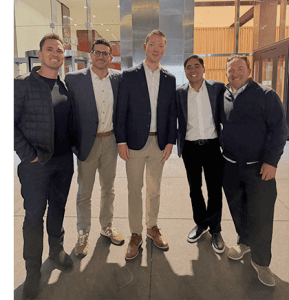 In October, SIOR celebrated its 85th anniversary at its Fall Conference in New York City. Eric Northbrook, SIOR, Voit’s Managing Director, Regional Sales and Leadership Development, attended this year’s four-day conference along with Ryan Moore, SIOR, Executive Vice President in the Anaheim office, and Senior Vice Presidents Alex Jize, SIOR, Josh West, SIOR, and Garrett Fena, SIOR, of the San Diego office. (Pictured are Moore, Jize, West and Fena at the conference with Craig Sampson, BFC Funding.) They gained deeper insights into the practical application of AI in dealmaking and workflows, the trends industrial developers and office owners are seeing in their asset classes, and the tools and tactics to better serve their clients. They also benefited from the economic forecast by Dr. Mark Zandi, chief economist of Moody’s Analytics.
Developer Insights
One of the most valuable industrial sessions Voit brokers attended was “The Developer’s Perspective: What’s Getting Built, Where, and What’s Next.” The discussion featured panelists Sheila Sutton, Senior Vice President, Head of Development for Prologis; Jeff Lanaghan, Senior Vice President, Development and Investments at Becknell Industrial; and Ian McDonald, Partner, Northeast Industrial Development at Panattoni. The panelists discussed a wide range of topics, including what occupiers demand from their buildings, what creates optimal development opportunities, and how data center development is affecting the overall industrial market. Below are some highlights from the panel discussion.
Siting New Developments
Panelists agreed that the number one factor when developers are considering where to build industrial properties—whether it’s warehouse/distribution, data centers, or advanced manufacturing facilities—is access to power. “Power is becoming more and more important to customers,” said Sutton, “making land [with access to power] more marketable [because] it’s such a hard resource to get.”
The second factor in site selection is access to labor, although McDonald noted that companies are increasingly seeking to reduce headcount through automation. He asserted that Panattoni’s automated buildings that once required 100 employees to operate now need only 25 to 35, though they require a more technical, skilled workforce.
The third factor is entitlement. “Unentitled land is worthless,” said moderator Ethan Smith, SIOR, Senior Vice President at Pearson Commercial, quoting a colleague from Prologis. Although the entitlement process varies radically by state, California and New Jersey were acknowledged as the most difficult, with approvals frequently taking years to secure. McDonald, who operates primarily in the Northeast for Panattoni, said the process typically takes 18 months for a National Pollutant Discharge Elimination System (NPDES) permit in Pennsylvania, but “in Ohio I got it in 24 hours.”
“For the deals that get done, it’s not necessarily a dot on the map,” concluded Lanaghan. “It’s going to be where the confluence of the land and the infrastructure comes together that makes it attractive for tenants, and that could be anywhere.”
Data Centers
While data center construction is receiving public pushback across the U.S., markets where development is moving forward are seeing increased demand for adjacent industrial space to house long-lead materials, prefabs, and components. Sutton said Prologis is seeing “five-, seven-, and ten-year leases” for buildings housing materials in support of data centers but cautioned that it is important to be diligent in vetting whether demand is real. While Prologis does have a data center team, Sutton focuses more on its core industrial product, working “hand-in-hand” with hyperscale developers “and really supporting them from that local perspective, knowing the local municipalities… where we can really help them is by being the boots on the ground, especially through the entitlements, the power applications, that kind of thing, and then leaving it to the experts of actual building, designing, and constructing the data centers.”
Lanaghan said Becknell will be constructing “some small-bay product” less than a quarter mile from an Amazon Web Services (AWS) data center in Indiana. “We certainly think that there will be some spillover from the data center. People are looking [at these buildings] not as advanced manufacturing or even industrial spaces. They’re becoming more infrastructure as opposed to just a building where they’re distributing out of. So, they’re looking for the automation; they’re looking for the power; they’re looking for the clear heights.”
Advanced Manufacturing
The emergence of a new class of occupiers, advanced manufacturers, is upending how firms like Prologis, Panattoni, and Becknell approach the development of these facilities. Although they require the same elements as any industrial facility—access to power, entitlement certainty, a skilled workforce, and access to highways and ports—the model does not lend itself to speculative development. “A lot of those manufacturing plants are not going into speculative buildings,” said Lanaghan. “They are so specialized and so expensive that [manufacturers] are looking to do build-to-suits.” That level of customization is also reshaping the development, leasing, and eventual sale of distribution facilities as they become more automated.
Sutton said distributors and third-party logistics (3PL) providers “now have very specific ways that they want to have their last-mile facilities operate, to the point [where] you’re putting so much automation in these buildings that there’s a concern from the customers about [ownership].” Tenants making large investments in their buildings ultimately want some control over those buildings. “So if we have an end user that wants to own the building—whether it’s immediately upon completion or a few years later—we’re really going to go with what the customer wants and what works best for them and work towards that.”
Construction Costs
The panelists were asked how they are addressing construction pricing uncertainty with their customers, given tariffs, rising material and oil prices, and escalating labor costs. McDonald said that his firm is “white-knuckling it right now with our underwriting… [trying to determine] what works and what doesn’t work. Over the last six months, it’s been a lot of hard conversations about things that looked right six months ago but aren’t so great today… If we’re looking at a deal today, we have to have a little bit of margin and safety.”
“It’s a partnership with the client,” said Lanaghan. “We’re vertically integrated, so we have great insight into what the engineering looks like, what the community needs are, and what the construction costs will look like, so we sit down with them, and the goal here is to eliminate as much uncertainty as we can.”
Why the SIOR Designation Matters
The SIOR designation has benefited not only the individual brokers who have earned the honor but also Voit as an organization. As Mike Vernick, SIOR, Senior Vice President/Partner in the Anaheim office, stated in our previous SIOR article, “At the end of the day, this business is really about integrity and ethics. Our clients are making significant financial decisions based on information that we’re providing them. So, we need to be a source of unbiased, reliable information so that they can make the best decisions possible. That’s what SIOR provides.”
Contact one of Voit’s SIOR-designated advisors to learn how their expertise can help you achieve your real estate goals.